
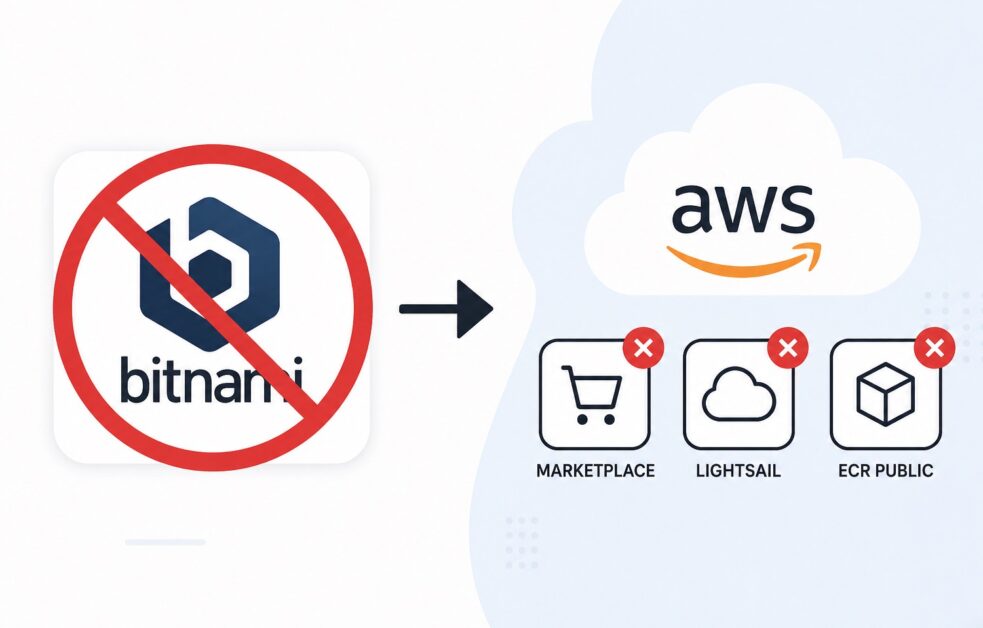
For more than a decade, Bitnami was one of the easiest ways to deploy popular open-source applications on Amazon Web Services (AWS). Whether you wanted to launch WordPress, PostgreSQL, Redis, Magento, Laravel, or dozens of other applications, Bitnami provided pre-configured images that significantly reduced setup time and operational complexity.
That convenience has now come to an end on AWS.
As of June 10, 2026, Broadcom has officially removed Bitnami-packaged content from AWS Marketplace, AWS Lightsail Blueprints, and Amazon ECR Public. The change affects developers, agencies, startups, and enterprise infrastructure teams that have relied on Bitnami-based deployment workflows for years.
This article explains what happened, why it happened, how it affects existing workloads, and what businesses should do next.
What Was Bitnami?
Bitnami is a software packaging platform that provides ready-to-deploy versions of popular open-source applications.
Instead of manually configuring a Linux server, installing dependencies, securing services, and maintaining updates, users could launch a Bitnami image and have a production-ready environment running within minutes.
Common Bitnami deployments included:
- WordPress
- PostgreSQL
- MySQL
- Redis
- MongoDB
- RabbitMQ
- Magento
- Drupal
- Jenkins
- NGINX
- Apache
For AWS users, Bitnami became particularly popular through AWS Marketplace and AWS Lightsail because it simplified deployment for both beginners and experienced administrators.
What Changed in June 2026?
Broadcom, which acquired VMware and subsequently gained ownership of Bitnami assets, officially discontinued the distribution of Bitnami-packaged content through AWS channels.
The removal affects:
- AWS Marketplace AMIs
- AWS Lightsail Blueprints
- Amazon ECR Public Bitnami container images
- AWS-distributed Bitnami Helm chart workflows
As a result, new deployments that depend on these AWS-hosted Bitnami resources can no longer access them.
Organizations that automatically pull images from Bitnami repositories on AWS may experience deployment failures if they have not already migrated to alternative sources.
Are Existing Servers Still Working?
Yes.
If you currently run a Bitnami WordPress server, database server, or application stack on AWS, the server itself will continue operating normally.
Your website will not suddenly go offline because of this change.
However, there is an important difference between a running server and a maintained server.
Existing Bitnami instances will no longer receive future updates, security improvements, or newly packaged releases through the AWS Bitnami ecosystem.
Over time, this can create security, compliance, and maintenance risks.
Why Did Broadcom Make This Decision?
Broadcom has been restructuring several VMware and Tanzu-related products since completing its acquisition activities.
The company appears to be focusing more heavily on enterprise-focused offerings and commercial support models.
While Broadcom continues to support enterprise solutions, many community users have expressed concern about reduced access to free, version-pinned, publicly distributed Bitnami packages that were previously available through AWS.
The result is a significant shift away from the deployment model that many developers have used for years.
How Does This Impact WordPress Users?
WordPress website owners are among the most affected groups because AWS Lightsail Bitnami WordPress instances became one of the most common ways to launch a WordPress site on AWS.
Potential impacts include:
No New Bitnami WordPress Deployments
Businesses can no longer launch new Bitnami WordPress instances directly from AWS Lightsail Blueprints.
Reduced Update Availability
Future Bitnami-packaged updates are no longer distributed through AWS.
Migration Planning Becomes Important
Organizations should evaluate whether their current infrastructure remains suitable for long-term operation.
Increased Responsibility
System administrators may need to handle operating system updates, application upgrades, and security maintenance themselves.
Impact on Kubernetes and DevOps Workflows
Many DevOps teams use Bitnami container images and Helm charts in automated deployment pipelines.
Typical examples include:
- Kubernetes clusters
- CI/CD pipelines
- Infrastructure-as-Code environments
- Auto-scaling container platforms
If these environments reference AWS-hosted Bitnami registries, deployment failures can occur when systems attempt to pull images that are no longer available.
Common symptoms may include:
- ImagePullBackOff errors
- Failed container deployments
- Broken CI/CD pipelines
- Missing dependency images
Infrastructure audits should be performed immediately to identify any remaining Bitnami dependencies.
How to Check if Your Infrastructure Uses Bitnami
For containerized environments, search deployment files for Bitnami references.
Examples include:
- Kubernetes manifests
- Helm values files
- Docker Compose files
- Terraform configurations
- CI/CD deployment scripts
Look for references containing:
- bitnami
- public.ecr.aws/bitnami
- docker.io/bitnami
Document every dependency before planning migration activities.
Recommended Alternatives
The best alternative depends on your environment.
For WordPress Websites
Consider:
- Native AWS Lightsail instances
- Standard Ubuntu servers
- Managed WordPress hosting
- Cloud hosting platforms with automated maintenance
For Databases
Consider managed services such as:
- Amazon RDS
- Amazon Aurora
- Amazon ElastiCache
Managed services often reduce operational overhead while improving security and availability.
For Containers
Use:
- Official Docker images
- Vendor-maintained container repositories
- Internal private registries
- Private Amazon ECR repositories
Many organizations are now mirroring critical images into their own registries to avoid future supply-chain disruptions.
What Agencies and Freelance Developers Should Do
If you manage websites or cloud infrastructure for clients, this is a good opportunity to review all AWS environments under your control.
Create an inventory of:
- WordPress installations
- Database servers
- Container workloads
- Kubernetes clusters
- CI/CD pipelines
Identify systems that still depend on Bitnami resources and develop a migration plan before future maintenance becomes difficult.
For agencies managing dozens or hundreds of websites, proactive planning today can prevent costly emergency migrations later.
Final Thoughts
The removal of Bitnami from AWS marks the end of an era for many developers and infrastructure teams. For years, Bitnami simplified application deployment and made cloud adoption easier for businesses of all sizes.
While existing systems continue to run, organizations should not treat this change as a temporary inconvenience. It represents a fundamental shift in how many open-source applications will be deployed and maintained going forward.
The best approach is to audit existing infrastructure, document dependencies, and begin transitioning toward supported long-term deployment strategies.
Businesses that act early will avoid future security risks, deployment failures, and rushed migration projects.