
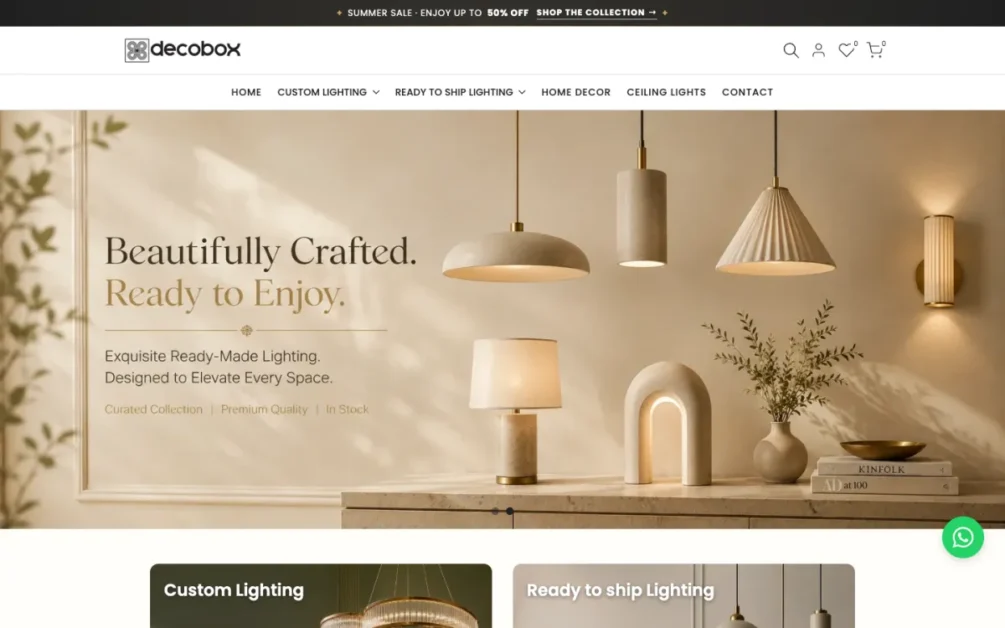
This Shopify lighting store case study covers Decobox, an Indian brand selling decorative chandeliers, pendant lights, wall lights, floor lamps, table lamps and home decor. The store sells two ways from one catalogue: custom-made lighting by enquiry, and ready-to-ship lighting with fixed prices and online checkout.
I’m Arul M Joseph, a WordPress, Shopify and Laravel developer with 14+ years of experience and 500+ websites delivered. This page explains how the Decobox store works, the Shopify decisions behind it, and the lessons to apply to your own home decor store.
Quick Summary
- Decobox is the consumer brand of Avizakta Enterprises, selling decorative lighting across India since 2020.
- The catalogue holds around 155 products split into Custom Lighting and Ready to Ship Lighting.
- Custom products show “Price Available on Request” and an Enquire Now form in place of Add to cart.
- Ready-to-ship products use standard Shopify pricing with sale prices, colour variants and checkout.
- Trust signals include a 1 year warranty, free shipping above Rs. 999, pan India delivery, 30 day exchange and customer video feedback.
Project at a glance
| Item | Details |
|---|---|
| Client | Decobox (Avizakta Enterprises) |
| Industry | Decorative lighting and home decor |
| Market | India, prices in INR |
| Platform | Shopify |
| Catalogue | About 155 products across 9 lighting categories |
| Sales models | Custom-made by enquiry, ready-to-ship with checkout |
| Live site | decobox.store |
What Was the Challenge for the Decobox Shopify Store?
The main challenge was selling two different kinds of product in one Shopify store. A Rs. 890 acrylic wall light and a made-to-order crystal chandelier need different buying journeys, and both had to feel like one brand.
Most Shopify themes assume every product has a price and an Add to cart button. Decobox needed a store where the theme decides, product by product, whether to sell or to collect an enquiry.
Two buying journeys in one catalogue
| Factor | Custom Lighting | Ready to Ship Lighting |
|---|---|---|
| Price display | Price Available on Request | Regular and sale price |
| Main button | Enquire Now | Add to cart |
| Options | Size, hanging height, glass colour, metal finish, light colour | Shopify variants such as Gold and Black |
| Lead time | Production time of about 30 working days | Ships from stock |
| Sales follow-up | Quote by email, phone or WhatsApp | Shopify checkout |
Why the buyer type matters
A custom chandelier buyer is often an architect, interior designer or homeowner planning a new space. They want to confirm size, finish and ceiling height before they talk about price. A ready-to-ship buyer wants to see the price, pick a colour and pay today.
If the store pushes both buyers through the same flow, one group leaves. Custom buyers see Rs. 0.00 or a sold out label and assume the product is unavailable. Ready-to-ship buyers hit an enquiry form and wait for a reply they did not want.
How Was the Decobox Catalogue Structured on Shopify?
The catalogue is split at the top level by buying model, then by product type. This keeps the menu short and tells the shopper how they will buy before they open a product.
- Custom Lighting: Custom Made Chandeliers, Wall Lights, Hanging Lights, Floor Lamps and Table Lamps.
- Ready to Ship Lighting: Readymade Chandeliers, Wall Lights and Hanging Lights.
- Home decor and Ceiling lights as separate menu items.
- Contact for project and trade enquiries.
A Shopify collection is a group of products shown on one page, either picked by hand or filled by rules such as a product tag or type. Decobox uses collections for each category, plus an All products view with filters for category, availability and price, and sorting by best selling, price and date.
Homepage merchandising
The homepage follows the same split. After the hero banners, two category tiles send shoppers to Custom Lighting or Ready to Ship Lighting. A Custom-made carousel and a Ready to Ship grid follow, then trust badges, customer video feedback and a newsletter signup.
| Homepage section | Job it does |
|---|---|
| Announcement bar | Promotes the current sale with a link to the collection |
| Hero banners | Sets the visual style of the brand |
| Category tiles | Splits shoppers by buying model in one click |
| Custom-made carousel | Shows new and popular made-to-order pieces |
| Ready to Ship grid | Shows fixed-price products with sale prices |
| Trust badges | Free shipping, 24/7 support, 30 day return, secure payment |
| Customer videos | Social proof from Instagram feedback |
| Newsletter | Captures visitors who are not ready to buy |
How Does the Custom Lighting Enquiry Flow Work?
Custom products replace the price with “Price Available on Request” and replace Add to cart with an Enquire Now button. The button opens a form with name, email, phone, product and message fields, and the product name fills in on its own.
The product page lists every customisation point in plain text: overall size, hanging height, glass colour, glass texture, metal finish, glass arrangement, light colour and ceiling plate. A specification table covers material, light source, voltage, installation and production time. The buyer arrives at the enquiry with most questions answered.
In practice, this looks like
The cleanest way to run both models in one theme is one rule, checked in one snippet. Here is a simplified version of the Liquid logic for the product form:
{%- assign is_custom = false -%}
{%- if product.tags contains 'custom-made' or product.price == 0 -%}
  {%- assign is_custom = true -%}
{%- endif -%}

{%- if is_custom -%}
  <p class="price">Price Available on Request</p>
  <button type="button" class="button" data-enquiry-open
    data-product="{{ product.title | escape }}">Enquire Now</button>
{%- else -%}
  {%- render 'price', product: product -%}
  {%- render 'buy-buttons', product: product -%}
{%- endif -%}
The same is_custom check needs to run in the product card, quick view and quick add snippets too. If one snippet misses it, a custom chandelier shows Rs. 0.00 in a collection grid or lets a shopper add a zero-price product to the cart.
How Do Ready-to-Ship Products Sell on Decobox?
Ready-to-ship products use standard Shopify pricing. Each product shows a regular price, a sale price and colour variants, with Add to cart, Add to Wishlist and Add to Compare.
A Shopify variant is one buyable version of a product, such as the Gold or Black finish of the Spiral Crystal Chandelier. Each variant carries its own price, stock and SKU. Read the details in the Shopify Help Center guide to variants.
Product cards show a second photo on hover and a New badge for fresh stock. Sale prices sit next to the struck-through regular price, for example the Spiral Acrylic Wall Light at Rs. 890 against Rs. 1,620.
How Does the Store Build Trust With Indian Buyers?
Decobox puts trust signals on the homepage and on every product page. Lighting is a high-value, fragile purchase, so buyers check warranty, delivery and returns before they order.
- 1 year warranty and a Premium Quality badge on product pages.
- Free shipping above Rs. 999 and pan India delivery.
- 30 day exchange with a linked refund and returns policy.
- 24/7 support by phone, email and WhatsApp.
- Customer video feedback from Instagram in the Some Good Things section.
- Business identity: the About page names Avizakta Enterprises and lists 10K+ customers and 500+ products.
- Installation note: product pages recommend professional installation and explain small variations from photos.
WhatsApp matters for this market. Many Indian buyers prefer to send a photo of their ceiling and ask a question on WhatsApp before they fill in a form, so the store links to WhatsApp in the footer and in the share buttons.
SEO, AEO and GEO Foundations
A lighting store ranks on category searches such as “crystal chandelier online India” and product searches such as a named chandelier model. The store structure supports both.
- Descriptive titles: the site title reads “Decobox | Decorative Lighting & Home Décor” and the meta description lists chandeliers, pendant lights, wall lights, table lamps and floor lamps.
- Collection pages per product type: each category gets its own URL to rank for its own search term.
- Specification tables: plain-text specs such as size, voltage and light source give search engines and AI tools facts to quote.
- Product structured data: Shopify themes output product schema. For custom products with no price, the schema needs checking against Google’s product structured data guidelines.
Secondary keywords
- Shopify home decor store
- custom chandelier ecommerce
- Shopify enquiry form for products
Step-by-Step: How I Approached the Decobox Shopify Store
- Map the two buying models. List which products sell by enquiry and which sell by checkout, and agree on one rule (a tag) for the split.
- Plan the collections. Build the menu around the buying model first, then the product type.
- Set up the product template. Add the enquiry button, the Price Available on Request label and the customisation list for custom products.
- Apply the rule everywhere. Use the same check in product cards, quick view, quick add, search results and the cart.
- Write a specification table. Use the same fields for every product, so shoppers compare like with like.
- Add trust signals. Warranty, shipping, returns, support and customer videos on the homepage and product pages.
- Connect WhatsApp and the contact form. Route every enquiry to the sales team with the product name attached.
- Test on mobile. Check large product galleries, image weight and the enquiry form on a phone.
Common Mistakes to Avoid in a Custom Lighting Shopify Store
- Using Rs. 0 as the only signal for custom products. Some theme snippets still print the zero price or allow checkout. Use a tag as the main rule.
- Mixing up stock labels. A custom product marked “sold out” tells the buyer it is unavailable. Use a “Made to order” label in its place.
- Copying text between products. A description written for one model and pasted into another confuses shoppers and search engines. Check names, specs and meta text on every product.
- Conflicting lead times. If one block says 30 working days and another says 4 weeks, the buyer trusts neither. Keep lead time in one metafield and print it everywhere.
- Theme defaults from another market. Free shipping text in dollars or for US orders on an INR store looks careless. Review every default string in the theme.
- Heavy product galleries. Chandelier pages often carry six or more photos and a video. Compress images and lazy-load everything below the first image.
FAQ: Shopify Lighting Store Case Study
Is Shopify good for a lighting and home decor store?
Yes. Shopify handles fixed-price products, variants, sale prices and checkout out of the box. Custom products need a small theme change to show an enquiry button in place of Add to cart.
How do you sell custom-made products on Shopify?
Tag the custom products, hide the price and Add to cart for those tags, and show an enquiry form with the product name filled in. Send the enquiry to email and WhatsApp so the sales team sends a quote.
Do you need an app for “Price on Request” on Shopify?
No. A Liquid condition in the theme covers it. An app helps when you want quote management, but the Decobox approach works with theme code and a contact form.
How long does a Shopify store like Decobox take to build?
For a store with around 150 products, two buying models and an enquiry flow, a typical build takes 3 to 6 weeks. Product data entry and photography usually decide the timeline more than the theme work.
What does a Shopify store like this cost in India?
Ecommerce stores on my plans start from Rs. 20,000. Custom enquiry logic, product upload and SEO add to the scope. See Shopify pricing for current plans.
What the Decobox Project Shows
- One Shopify store sells both made-to-order and ready-to-ship products when one rule controls the buying flow.
- Splitting the menu by buying model tells shoppers how they will buy before they open a product.
- Plain-text specifications and trust signals answer most buyer questions before the enquiry.
- WhatsApp and video feedback fit how Indian buyers shop for home decor.
Planning a Shopify store with custom products, quotes or a large catalogue? See my Shopify design and development service, check the SEO launch package, or get a free quote for your project.