
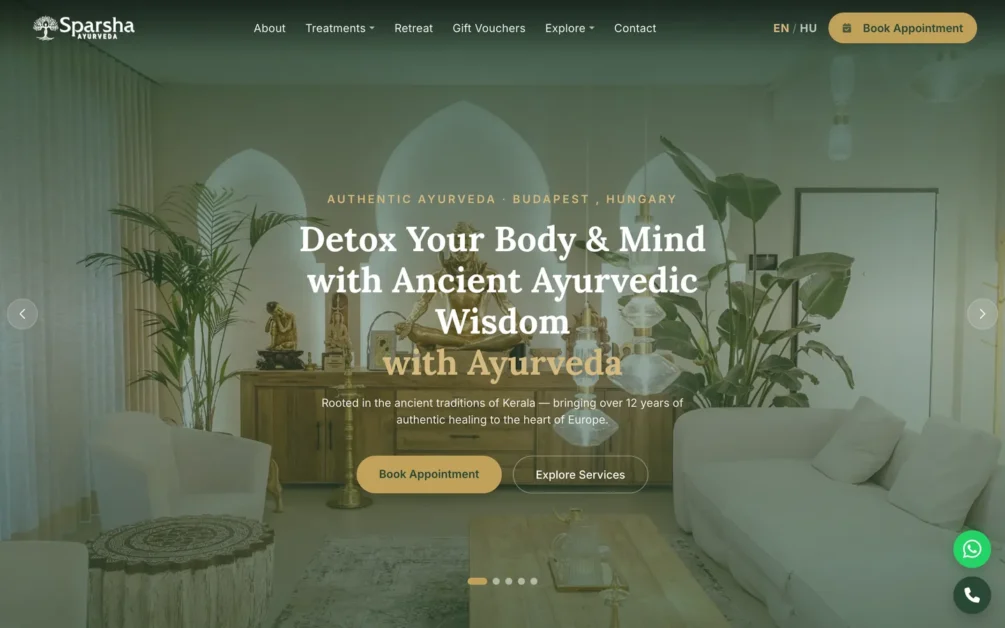
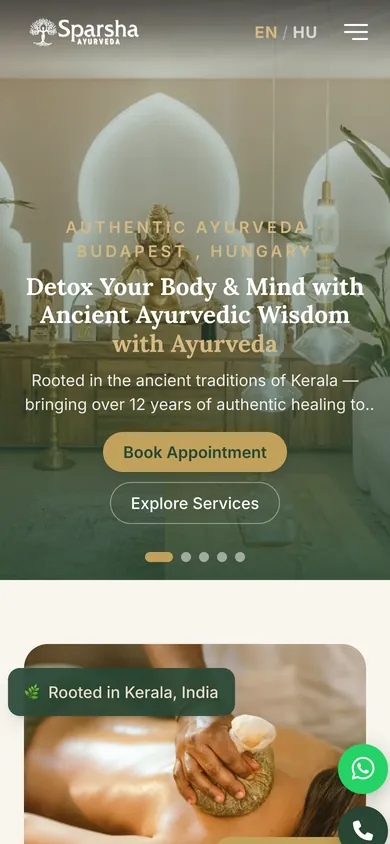
This Ayurveda website design case study covers Sparsha Ayurveda, a Kerala-style Ayurveda centre in central Budapest, Hungary. The site is a bilingual WordPress website in English and Hungarian. It presents six treatment areas, a Panchakarma retreat, gift vouchers and a booking form with prices in HUF.
I’m Arul M Joseph, a WordPress, Shopify and Laravel developer with 14+ years of experience and 500+ websites delivered. I designed and developed the Sparsha Ayurveda website. This page explains how the site is structured, the decisions behind it, and the lessons to apply to your own Ayurveda or wellness clinic website.
Quick Summary
- Sparsha Ayurveda is an Ayurveda wellness centre at Káldy Gyula utca 4, 1061 Budapest, led by Ayurvedic and Panchakarma specialist Girish Mokeri.
- The website runs on WordPress with a custom theme and full English and Hungarian versions.
- Treatments sit in six groups: Ayurveda Consultation, Ayurveda Massage Therapy, Pure Relaxation, Ayurveda Cure, Women Care and Ayurveda Beauty Therapy.
- The booking form lists 24 services with duration and HUF price in one dropdown, plus a preferred date and time slot.
- Trust signals include Google reviews, a YouTube testimonial video, a founder profile and a WhatsApp button on every page.
Project at a glance
| Item | Details |
|---|---|
| Client | Sparsha Ayurveda Centre |
| Industry | Ayurveda treatments, wellness and Panchakarma retreats |
| Location | Budapest, Hungary (District VI, near St. Stephen’s Basilica) |
| Languages | English and Hungarian |
| Platform | WordPress with a custom theme |
| Pricing | Treatments in HUF, retreats in EUR |
| Main goal | Turn visitors into booked consultations and treatments |
| Live site | sparshacare.com |
What Was the Challenge for the Sparsha Ayurveda Website?
The main challenge was explaining Kerala Ayurveda to a European audience and getting them to book. Most visitors in Budapest do not know terms such as Abhyanga, Shirodhara or Panchakarma. The site had to explain each treatment in plain words, show the price, and make booking simple in two languages.
A wellness clinic website also carries a trust problem. Visitors want to know who treats them, where the centre is, and what other guests say before they book a 100-minute massage or a 14-day retreat.
Who visits an Ayurveda centre website
| Visitor | What they want | Where the site answers |
|---|---|---|
| Local Hungarian resident | A relaxing massage or facial, in Hungarian, with a clear price | Hungarian pages, treatment pages, booking dropdown with HUF prices |
| Expat or tourist in Budapest | An English-speaking centre near the city centre | English pages, address, map and opening hours |
| Guest with a health concern | A consultation for joint pain, digestion, skin or migraine | Ayurveda Cure sub-pages and the consultation page |
| Retreat traveller | A multi-day Panchakarma programme with a daily price | Retreat page with 7, 10, 14 and 21 day plans |
| Gift buyer | A voucher for someone else | Gift Vouchers page in the main menu |
How Is the Ayurveda Treatment Menu Structured?
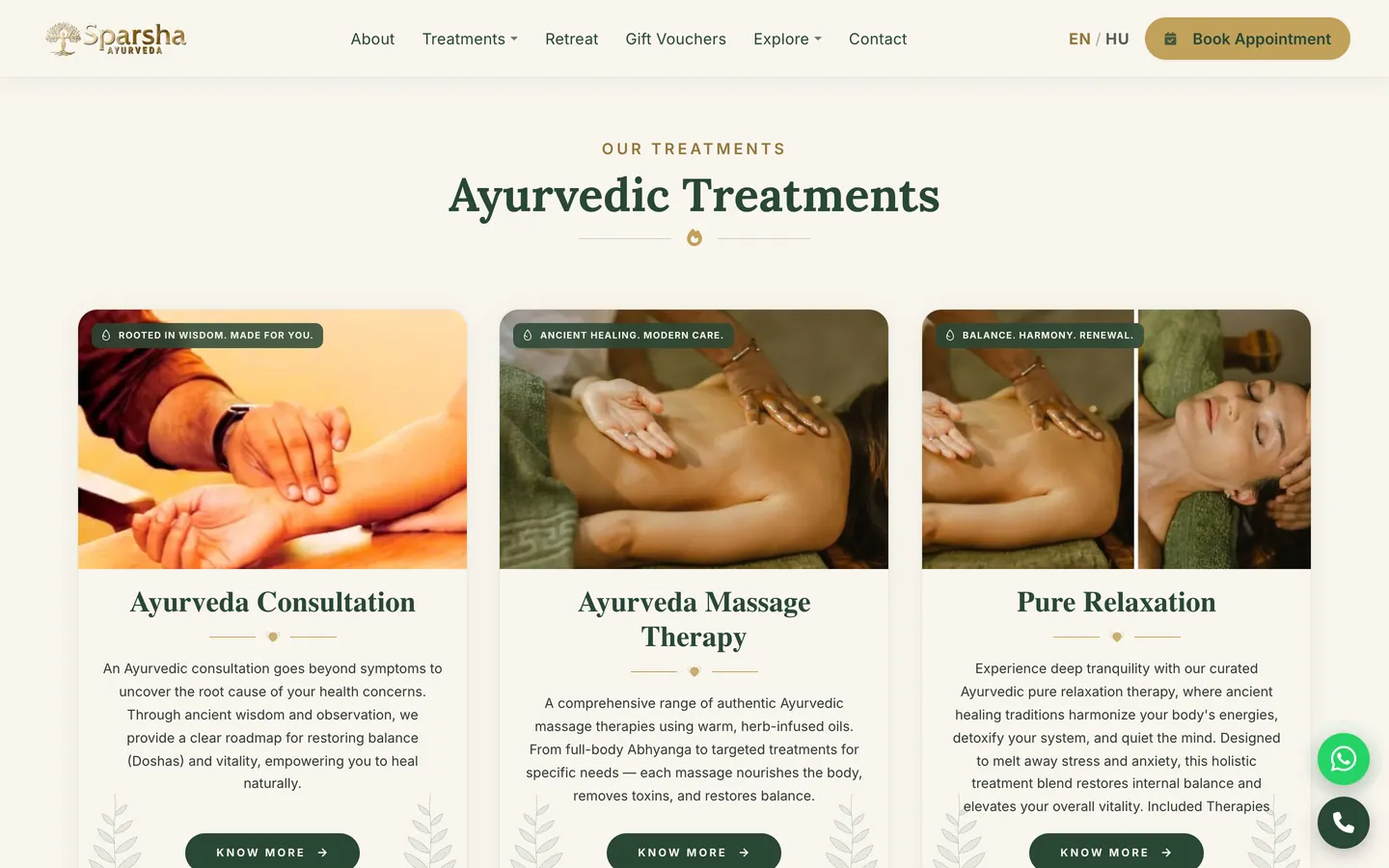
The treatment menu groups more than 20 therapies into six parent categories, each with its own page and sub-pages. Visitors pick a goal first, such as relaxation or women’s health, then read the treatments inside it.
- Ayurveda Consultation: the starting point, with pulse and tongue diagnosis.
- Ayurveda Massage Therapy: Abhyanga, Kizhi and other oil therapies.
- Pure Relaxation: Pure Relaxation Therapy, and Pure Relaxation with Ayurvedic Facial.
- Ayurveda Cure: eight condition pages, including Panchakarma, joint pain, healthy slimming, digestive disorders, sinusitis and migraine, skin diseases and metabolic disorders.
- Women Care: gynaecological issues, infertility treatment, and pre-natal and post-natal care.
- Ayurveda Beauty Therapy: clear skin and scalp care, Ayurveda facial, and skin and hair care.
Child pages follow one URL pattern, for example /treatments/ayurveda-cure/digestive-disorders/. A hierarchical URL is a page address where each folder matches a level of the menu. It tells Google and AI search tools how each treatment relates to its category.
Homepage sections and the job each one does
| Homepage section | Job it does |
|---|---|
| Hero slider | States the offer, with Book Appointment and Explore Services on every slide |
| Why choose Sparsha | Covers experience in Europe, Kerala heritage and equipment imported from India |
| Our Treatments | Six cards linking to each treatment category |
| Real Experiences | A YouTube testimonial video and a link to the channel |
| Panchakarma section | Explains detox therapy and links to the Panchakarma page |
| Testimonials | Google reviews in English, Hungarian and French |
| Interesting Facts | Short Ayurveda tips for first-time visitors |
| Founder section | Introduces Girish Mokeri with a Dosha Test button |
| Latest Articles | Three recent posts from the Journal |
| Closing CTA | Book Appointment and Gift Voucher buttons |
How Does the Booking Form Work?
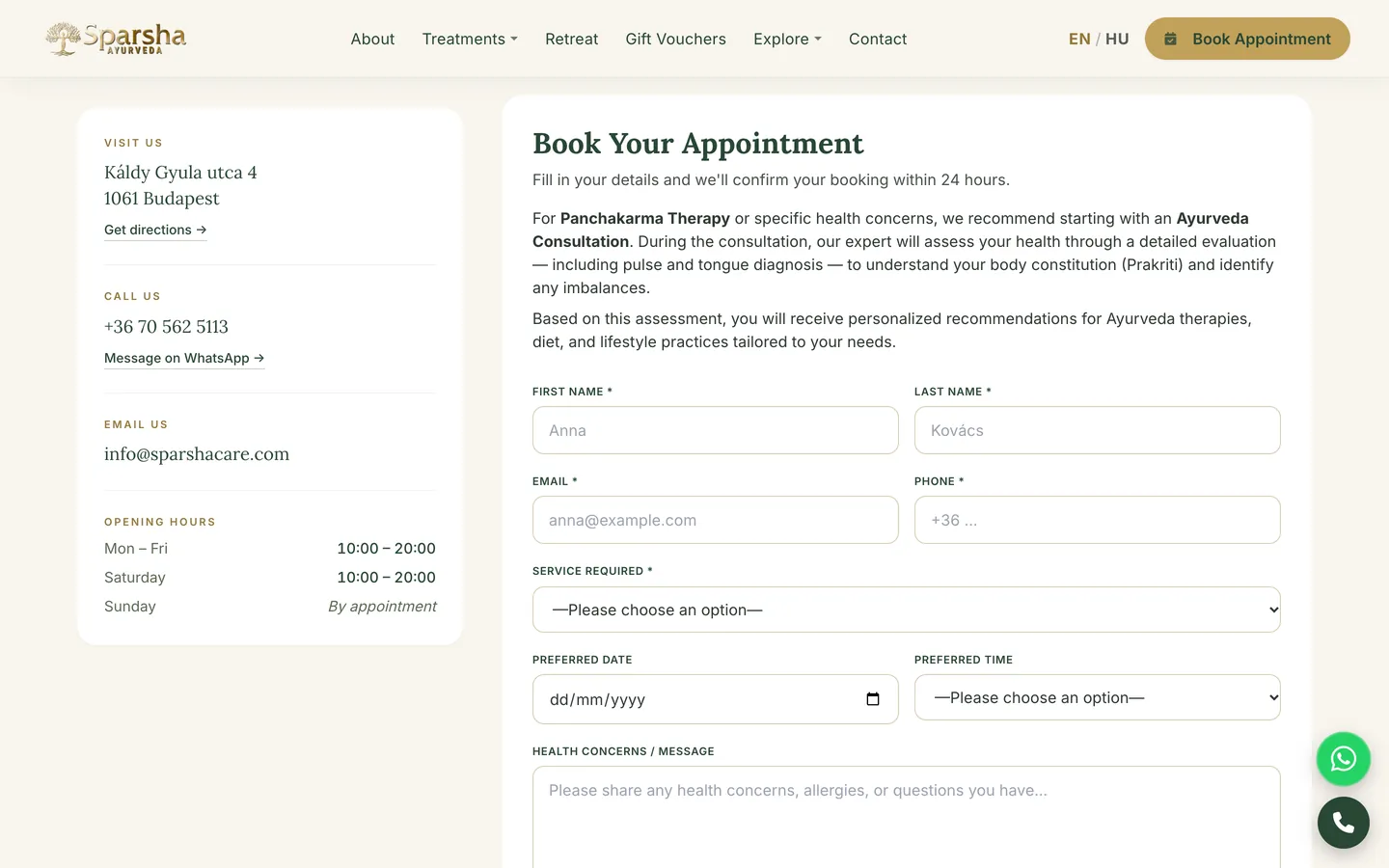
The Contact page holds one booking form with the full price list built into the Service Required dropdown. Each option shows the treatment name, the duration and the HUF price, so the visitor sees the cost before sending the request.
The form asks for first name, last name, email, phone, service, preferred date, preferred time slot and health concerns, with a GDPR consent checkbox. The page promises a booking confirmation within 24 hours. Opening hours, the address, a Google Map and a Get directions link sit next to the form.
Sample treatments from the booking dropdown
| Treatment | Duration | Price (HUF) |
|---|---|---|
| Ayurvedic consultation | 45 min | 13,000 |
| Abhyanga herbal oil massage and Swedana | 70 min | 15,000 |
| Shirodhara | 60 min | 15,000 |
| Shirodhara and Abhyanga | 120 min | 35,000 |
| Mukhalepam Ayurvedic facial | 60 min | 22,000 |
| Pure relaxation | 2.5 hours | 49,900 |
Prices are from the live booking form in November 2026. Check sparshacare.com/contact for current rates.
In practice, this looks like
Storing duration and price in the option label keeps one source of truth for the front end and the enquiry email. Here is a simplified version of the WordPress loop for the dropdown, reading each treatment from a custom field:
<select name="service" required>
  <option value="">Select a service</option>
  <?php foreach ( get_posts( array( 'post_type' => 'treatment', 'numberposts' => -1, 'orderby' => 'menu_order', 'order' => 'ASC' ) ) as $t ) :
    $label = sprintf( '%s (%s) %s HUF', get_the_title( $t ),
      get_field( 'duration', $t ), number_format( get_field( 'price_huf', $t ) ) ); ?>
    <option value="<?php echo esc_attr( $label ); ?>"><?php echo esc_html( $label ); ?></option>
  <?php endforeach; ?>
</select>
The value carries the full label, so the email to the clinic shows the treatment, duration and price the visitor picked. When the clinic changes a price, it updates one field and the form, the email and the treatment page stay in line.
How Does the Panchakarma Retreat Page Sell a Multi-Day Programme?
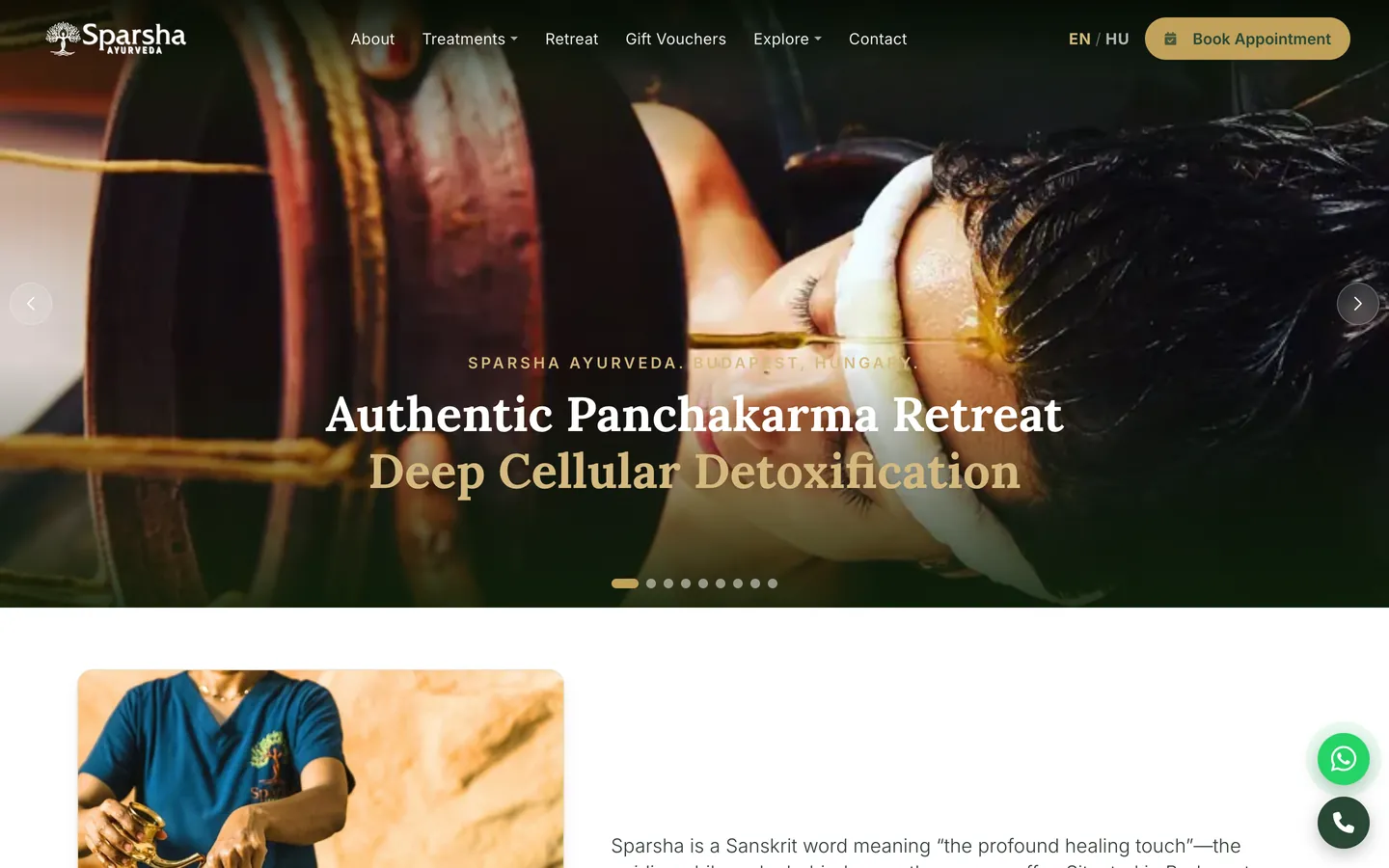
The retreat page sells a longer, higher-value stay with a clear daily rate. It lists the daily programme, four plan lengths and the accommodation option on one page, with a Schedule a Consultation button.
Panchakarma is a traditional Ayurvedic detox programme of oil therapies, steam and supervised cleansing, run over several days. The page describes a dosha assessment before the start, about two hours of therapies each day, and daily check-ins with the consultant.
| Plan | Daily rate | Total |
|---|---|---|
| 7 days | EUR 100 | EUR 700 |
| 10 days | EUR 100 | EUR 1,000 |
| 14 days | EUR 100 | EUR 1,400 |
| 21 days | EUR 100 | EUR 2,100 |
Full board meals are listed at EUR 60 per day. Private apartments near the clinic are available, and the team helps guests book them.
How Does the Website Build Trust With Wellness Clients?
The site places proof from real guests and a named practitioner on the homepage, the About page and every treatment page. A wellness visitor books with a person, so the founder and guest reviews do most of the work.
- Google reviews: a review widget pulls reviews in English, Hungarian and French.
- Video testimonial: a YouTube guest video in the Real Experiences section.
- Named founder: Girish Mokeri, an Ayurvedic and Panchakarma specialist from Kerala, with a profile on the homepage and About page.
- Team section: photos of the therapists on the About page.
- Location proof: full address, Google Map, opening hours and a Get directions link.
- Clear prices: every bookable treatment shows duration and price before the request.
- WhatsApp: a floating WhatsApp button on every page for quick questions.
- Policies: Privacy Policy, Terms of Use and GDPR consent on the form.
How Was the Site Made Multilingual for Hungary?
Every main page has a full Hungarian version with translated URLs, such as /hu/kezdolap/ for the homepage and /hu/rolunk/ for About. An EN and HU switch sits in the header.
Translated slugs matter for local search. A Hungarian visitor searching for “ajurvéda masszázs Budapest” is more likely to click a Hungarian page with a Hungarian URL and title. Each language version needs hreflang tags, which are HTML tags telling Google which page serves which language. See Google’s guide to localized versions.
SEO, AEO and GEO Foundations
An Ayurveda centre ranks on treatment searches such as “Shirodhara Budapest” and on intent searches such as “Ayurveda massage near me”. The site structure supports both with one page per treatment and strong local signals.
- Descriptive titles and meta descriptions: for example “Ayurvedic Treatments in Budapest | Sparsha Ayurveda” and “Contact & Booking | Sparsha Ayurveda Budapest”.
- One page per treatment and condition: each page targets its own search term in both languages.
- Local business details: the same address, opening hours and map on every contact point.
- FAQ and Journal: a FAQ page and articles on Panchakarma, the five elements and psoriasis care give AI search tools plain answers to quote.
- Structured data: a wellness centre fits the HealthAndBeautyBusiness type with address, opening hours and geo coordinates.
Secondary keywords
- WordPress website for Ayurveda clinic
- wellness centre website design
- multilingual WordPress website Hungary
Step-by-Step: How I Approached the Sparsha Ayurveda Website
- Map the treatments. Group every therapy under a goal the visitor understands, and agree on six parent categories.
- Plan the URLs. Use one parent page per category and child pages for each treatment or condition.
- Write plain explanations. Explain each Sanskrit term in one or two sentences before the details.
- Build the booking form. Put duration and price in every service option, and add date, time slot and GDPR consent.
- Add the retreat page. Show the daily programme, plan lengths, daily rate and accommodation on one page.
- Add trust signals. Founder profile, team photos, Google reviews, video testimonial and WhatsApp.
- Translate into Hungarian. Translate pages, menus and URL slugs, then link each pair with hreflang.
- Test on mobile. Check the hero slider, the treatment menu, the form and the WhatsApp button on a phone.
Common Mistakes to Avoid on an Ayurveda Clinic Website
- Using Sanskrit names with no explanation. A European visitor does not search for “Udwarthanam”. Add a plain name such as “herbal powder slimming massage”.
- Hiding prices. Visitors leave when they cannot find a price. Show duration and price on the treatment page and in the form.
- Unsupported health claims. Claims about curing diseases hurt trust and break advertising rules in the EU. Describe what the treatment involves, and link to a consultation for medical questions.
- Mixed location details. Image file names, social handles or text copied from a sister clinic in another city confuse Google. Check every file name and link against the real address.
- Translating pages but not URLs. An English slug on a Hungarian page weakens local search. Translate the slug, title and meta description.
- Inconsistent numbers. If one section says 12 years and another says a decade, visitors trust neither. Keep key facts in one place and reuse them.
FAQ: Ayurveda Website Design Case Study
Is WordPress a good platform for an Ayurveda clinic website?
Yes. WordPress handles treatment pages, a blog, booking forms and multilingual content with one admin. A custom theme keeps the site fast and lets the clinic update prices and text without a developer.
What pages does an Ayurveda centre website need?
Most Ayurveda centres need a homepage, an About page with the practitioner, one page per treatment group, a booking or contact page with prices, a FAQ and a blog. A retreat page and gift vouchers add higher-value sales.
How do you add online booking to an Ayurveda website?
Add a booking form with the service list, durations and prices, a preferred date and time slot, and a consent checkbox. Send each request to the clinic by email, and confirm the slot by phone or WhatsApp.
Should a clinic website in Hungary be in English and Hungarian?
Yes, for a centre in Budapest serving locals and expats. Use full Hungarian pages with translated URLs and hreflang tags, so each language version ranks for its own searches.
How much does an Ayurveda website like this cost?
The cost depends on the number of treatment pages, languages and booking features. See my Ayurvedic website design page for plans, or ask for a free quote.
What the Sparsha Ayurveda Project Shows
- Grouping treatments by visitor goal makes a long therapy list easy to browse.
- Prices and durations inside the booking form remove the biggest reason visitors leave.
- A named founder, guest reviews and video testimonials build trust for a personal service.
- Full Hungarian pages with translated URLs serve local searches in Budapest.
Planning a website for an Ayurveda centre, spa or wellness clinic? See my Ayurvedic website design service, the WordPress design and development service, check the SEO launch package, or get a free quote for your project.