
Case Study by Arul M Joseph — Freelance Web Designer & Developer | Shopify Partner
Quick Summary
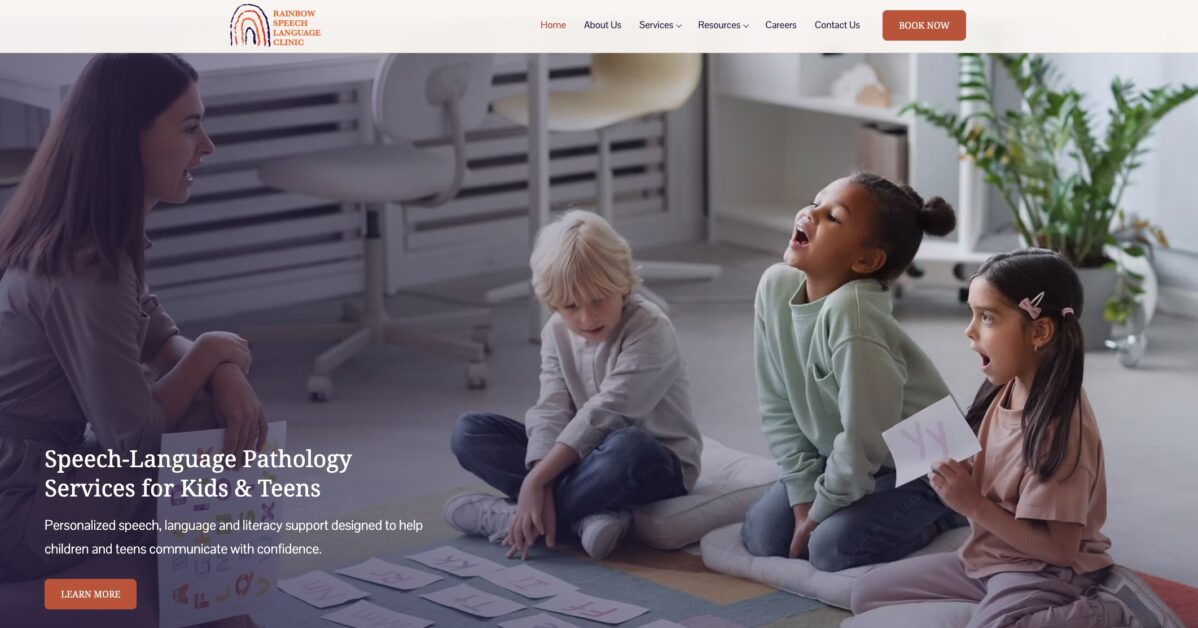
Rainbow Speech Language Clinic is a pediatric speech-language pathology practice serving families across Delta and Surrey, British Columbia.
Their previous website was built on Wix. It looked professional and provided the information parents needed, but it wasn’t fully supporting the clinic’s long-term growth goals, local search visibility, or the way modern families search for healthcare information online.
The goal of this project wasn’t simply to redesign a website.
It was to create a digital experience that would:
- Help worried parents find answers quickly.
- Improve visibility in Google Search.
- Support AI-powered search experiences such as ChatGPT, Perplexity, and Google’s AI Overviews.
- Build trust before a parent ever picks up the phone.
- Create a technical foundation that could grow with the clinic for years to come.
The result was a complete rebuild on custom WordPress, with a stronger content structure, better local SEO foundations, improved performance, and a website designed around real parent questions rather than internal business categories.
The Challenge
When most people think about healthcare websites, they focus on design.
In reality, design is only one piece of the puzzle.
The bigger challenge is understanding why someone is visiting the website in the first place.
Parents don’t usually land on a speech therapy website because they’re curious.
They arrive because something is worrying them.
Their toddler isn’t talking yet.
A teacher has raised concerns.
Their child struggles to pronounce certain sounds.
They’ve been referred for an assessment.
They’re searching for reassurance, guidance, and clarity.
Many are searching late at night after spending hours reading conflicting information online.
That emotional reality shaped the entire project.
The website needed to do more than look professional.
It needed to reduce anxiety, answer questions clearly, and help families feel confident about taking the next step.
Why We Moved Away From Wix
Wix is a good platform for many small businesses.
For local service businesses that simply need an online presence, it can work perfectly well.
However, healthcare practices have unique requirements.
They need strong local visibility, complete control over content structure, advanced SEO flexibility, and the ability to adapt as search behaviour evolves.
As search increasingly shifts toward AI-generated answers, websites need more control over how information is structured and presented.
A custom WordPress website provides:
- Full control over page structure and markup.
- Better flexibility for structured data and schema implementation.
- Greater control over performance optimization.
- Easier long-term content expansion.
- Improved ability to organize information for both search engines and AI systems.
The move wasn’t about Wix being bad.
It was about removing limitations and creating a stronger foundation for the future.
Understanding How Parents Actually Search
One of the biggest mistakes healthcare websites make is organizing content around the clinic’s internal structure.
Most websites start with:
- About Us
- Our Team
- Services
- Contact
That’s how a clinic sees itself.
It’s not how parents think.
Parents typically move through a very different journey:
Step 1: Can I Trust These People?
Before looking at services, most parents want reassurance.
They want to know:
- Is this clinic experienced?
- Will my child feel comfortable here?
- Do these therapists understand children?
- Will we be judged?
This is why the homepage and About page were designed to build trust first.
Step 2: Is This Relevant To My Child?
Once trust begins to form, parents start looking for answers.
They ask:
- Does my child need speech therapy?
- What happens during an assessment?
- What is language delay?
- What if my child has autism?
- Do you help with stuttering?
This is where the service pages come in.
Instead of overwhelming visitors with clinical terminology immediately, information is presented in a clear and approachable way.
Step 3: What Happens Next?
Before booking, most parents still have questions.
Questions about:
- Referrals
- Reports
- Funding
- Therapy sessions
- Assessments
- Insurance
Rather than hiding these answers across multiple pages, we built a dedicated FAQ section that addresses these concerns directly.
Step 4: Reach Out
Only after parents feel informed and reassured are they ready to contact the clinic.
The website supports this journey naturally rather than forcing visitors toward a conversion before they’re ready.
Creating Helpful Resources For Families
One of the most valuable additions to the website was a set of free speech and language development checklists.
These resources help parents understand what communication milestones may be expected at different ages.
Rather than immediately asking visitors to book an appointment, these pages provide useful information first.
This approach benefits families because they receive genuine value.
It also benefits search visibility because many parents search for questions such as:
- Signs of speech delay in toddlers
- Speech development milestones
- Does my child need speech therapy?
- Language delay checklist
- Speech delay symptoms
These are exactly the types of questions that appear in Google searches and AI-generated answers.
Providing clear, helpful content allows the clinic to become part of that conversation.
Designing For Trust, Not Just Appearance
Every visual decision on the website was made with a purpose.
Showing The Actual Clinic Environment
Parents often wonder:
“What will this feel like for my child?”
Instead of relying solely on text descriptions, the website includes real photographs of the clinic environment.
Visitors can see:
- Therapy rooms
- Child-friendly spaces
- Learning environments
- The overall atmosphere
This immediately reduces uncertainty.
Making Teletherapy Easy To Find
Many families balance work schedules, school schedules, and transportation challenges.
Teletherapy wasn’t hidden on a separate page.
It was integrated directly into the user journey so families immediately know remote support is available.
Highlighting Both Clinic Locations
Rainbow Speech Language Clinic serves families from two locations:
- Delta, BC
- Surrey, BC
Both locations are visible throughout the website rather than being buried on a contact page.
This improves usability for visitors and strengthens local search relevance.
Writing Content That Sounds Human
Healthcare websites often make the mistake of sounding like academic journals.
Parents aren’t looking for academic papers.
They’re looking for understanding.
Throughout the site, content was written using clear, natural language whenever possible.
For example:
“Our sessions are child-led, strengths-based, and play-focused. We follow each child’s interests, keep learning fun, and focus on skills that support real-life communication and confidence.”
Simple.
Human.
Approachable.
However, when parents reach assessment-specific pages, the language becomes more precise.
Terms such as:
- Childhood Apraxia of Speech
- AAC
- Phonological Disorders
- Expressive Language Delay
are used appropriately because visitors on those pages are often already familiar with those diagnoses.
The tone changes based on where parents are in their journey.
Why The FAQ Page Became One Of The Most Important Pages
The FAQ page may be the most valuable page on the entire website.
It serves both humans and search engines exceptionally well.
Questions include:
- Do I need a referral to book an appointment?
- How do I know if my child needs speech therapy?
- Will I receive a written report?
- What funding options are available?
- How long does therapy take?
These are real questions parents ask every day.
Each answer is written as a clear standalone response.
This helps visitors quickly find information.
It also helps search engines and AI systems understand the content more easily.
Modern AI systems prefer information that is:
- Clearly structured
- Easy to extract
- Written in question-and-answer format
- Specific and direct
Instead of forcing AI systems to interpret large blocks of text, the website provides clean answer sections that can be understood immediately.
The rule was simple:
Don’t make people work hard to find answers. Don’t make AI work hard either.
Building For Google Search And AI Search
SEO today is no longer just about ranking on Google.
People increasingly ask questions directly inside:
- ChatGPT
- Google AI Overviews
- Perplexity
- Gemini
- Voice assistants
To support this shift, the website was structured around topics and questions rather than just keywords.
Examples include:
- How do I know if my child needs speech therapy?
- What age should a child start talking?
- Do I need a referral for speech therapy?
- What happens during a speech assessment?
- What are signs of language delay?
These questions mirror how people naturally search.
The clearer the answer, the more likely it is to appear in traditional search results and AI-generated responses.
The Technical Foundation
While content and design matter most to visitors, technical foundations matter enormously to search visibility.
The new website includes:
Custom WordPress Theme
A fully custom-built theme provides complete control over structure, performance, and scalability.
Optimized Images
Images are delivered through Optimole CDN using modern formats such as AVIF and WebP.
This improves loading speed across devices.
Structured Metadata
Every page includes clean metadata and social sharing information.
Search Console Integration
Google Search Console was configured from the beginning to monitor indexing, search visibility, and technical health.
Analytics Tracking
Visitor behaviour can now be monitored and improved over time.
Clean Crawlability
Search engines can easily discover and understand every important page.
Mobile-First Design
Most parents visit from mobile devices.
The website was designed with mobile usability as a priority rather than an afterthought.
Strengthening Local Search Visibility
Local SEO was a major focus throughout the rebuild.
Consistency matters.
Business information was kept consistent across the website, including:
- Clinic name
- Addresses
- Phone number
- Service information
Both Delta and Surrey locations are represented clearly throughout the site.
This helps search engines connect the website with local business listings and location-based searches.
The team’s professional credentials and regulatory information were also made visible.
Trust signals matter significantly in healthcare-related search results.
Results Beyond Rankings
The success of a healthcare website isn’t measured only by traffic.
What matters more is whether the right people find it.
A successful visitor journey looks like this:
A worried parent searches for answers.
They find the website.
They quickly understand what the clinic does.
They feel reassured.
They get answers to their questions.
They feel comfortable reaching out.
That’s the outcome the project was designed around.
Key Takeaways
This project reinforced a lesson I see repeatedly across healthcare websites:
Good SEO and good user experience are usually the same thing.
The best-performing pages aren’t necessarily the most optimized.
They’re often the most helpful.
When content answers real questions clearly:
- People trust it more.
- Search engines understand it better.
- AI systems can cite it more confidently.
Modern websites need to serve both human visitors and machine readers.
When you do both well, visibility follows naturally.
Built As A Custom Theme, Not A Page Builder Website
One detail that’s worth mentioning is that this wasn’t a typical WordPress website built with Elementor, WPBakery, or another visual page builder.
The entire website was developed as a custom WordPress theme using Tailwind CSS, with clean semantic HTML, lightweight code, and only the functionality the clinic actually needed. There are no bulky page builder frameworks loading hundreds of unnecessary scripts and styles on every page.
This approach gives significantly more control over performance, accessibility, structured data, and SEO. Pages load faster, search engines can understand the content more clearly, and future updates are easier to maintain without fighting against a page builder’s limitations.
From an AI-search perspective, this matters as well. Clean semantic markup helps search engines and AI systems identify headings, content sections, FAQs, service information, and location details more accurately. Combined with schema markup, structured content, and optimized performance, the site provides stronger signals about what the content means—not just what it says.
The result is a faster, leaner website that prioritizes user experience, search visibility, and long-term scalability rather than relying on heavy visual builder tools that often sacrifice performance for convenience.
Final Thoughts
Moving Rainbow Speech Language Clinic from Wix to a custom WordPress platform wasn’t just a technical upgrade.
It was an opportunity to rethink how families experience the website from the moment they arrive.
Every decision—from the content structure and FAQs to the photography, page organization, and technical SEO foundation—was made with one goal:
To help parents find answers, feel supported, and confidently take the next step.
Because at the end of the day, the best healthcare websites aren’t the ones with the fanciest design.
They’re the ones that make people feel understood.
And increasingly, they’re the ones that make it easy for search engines and AI systems to understand them too.
About The Project
Rainbow Speech Language Clinic serves children and families across Delta and Surrey, British Columbia, offering assessments, therapy, consultations, teletherapy services, and communication support tailored to each child’s needs.
The website was rebuilt on a custom WordPress framework with a focus on local SEO, AI search visibility, content strategy, performance optimization, and user experience.
About The Author
I’m Arul M Joseph, a freelance web designer and developer based in Kerala, India, working with businesses and healthcare providers across Canada, the United States, Australia, the UAE, and beyond.
I specialize in custom WordPress websites, Shopify development, local SEO, and AI-search-ready content structures that help businesses become more visible where modern customers are searching.
Whether it’s a healthcare practice, local service business, or eCommerce brand, my focus is always the same:
Build websites that people trust, search engines understand, and AI systems can confidently reference.